

As I mentioned in the first article of this series, the very first insurance contracts were drawn up, not in a coffeehouse in London as so many believe, but in Medieval Italy:
Has Insurance Always Been This Way?

Regular readers of “0 Omissions” have probably noticed I’ve slowed down my output for this newsletter. It’s not because there’s been a slowdown of coverage gaps to talk about, I can assure you! But I’ve been deeply enthralled by some deeper questions; what’s it all for? Why does insurance exist? Does society need or benefit from the institution of insur…
To recap; sailing ships was a risky, expensive venture. It would cost a small fortune to get a merchant vessel up and running. You need to secure the goods, hire a crew, stock the ship for the trip. If you lost a ship to bad weather or pirates, you might very well lose everything.
To help finance these voyages, merchants would often take what was called a “Sea Loan”. Someone else, another merchant or a group of merchants, could finance the voyage. The financiers put up the money so that the merchant could purchase the goods, hire the crew, and send off the ship. Per the terms of the Sea Loan, if the ship was lost then the financiers were not legally able to recoup their loss.
That’s a great way to share the risk! Finance part of my voyage. If I succeed, you get paid a hefty interest back. If I lose it all, you only lose the principal of the loan. This method of risk transference and finance was used all the way back during the Roman era.
But we don’t use the Sea Loan anymore. So what happened?
The Catholic Church happened. Pope Gregory IX issued the Naviganti which effectively criminalized the Sea Loan. Why did the Church have a problem with the Sea Loan? Usury, the practice of lending money at extremely high interest rates, was a large part of the Sea Loan.
In order to justify making a Sea Loan, financiers and merchants had to use usurious rates. Estimates range between 20% - 30% was charged for each trip, which annualized could be anywhere from 80% to 185% since an average voyage lasted about 3, maybe 4 months. And with gross cargo profit margins ranging 10% - 50% a voyage….even if every trip was successful, a merchant who used a sea loan didn’t have very wide profit margins.
With the Church’s prohibition on usury, merchants had to devise a new way to share risk.
To help explain this new risk transference method, let’s go visit a tavern back in Medieval Genoa, Italy and see it come about.
In a Medieval Genoese Tavern…
Ambroxio bursts into the tavern and looks hurriedly for his party. His face is etched in fatigue, the fatigue that sets in after a few nights of poor sleep. He sees his friend back in the corner of the tavern and hurries over. Without any warning or greeting he plops across his friend who is combing through his notes while caressing a cup of wine. The friend looks up in surprise at his companions’ abrupt entrance.
“Ambroxio?”
Ambroxio doesn’t look up. He sets his hat down and wipes his forehead with a handkerchief. Whether the perspiration is from the warm weather or the problem that’s causing him stress is unclear. Without looking up he sighs, “Greetings, Luchino, my friend. How are you?”
“Well.” Luchino studies his friend. “You don’t look well at all.”
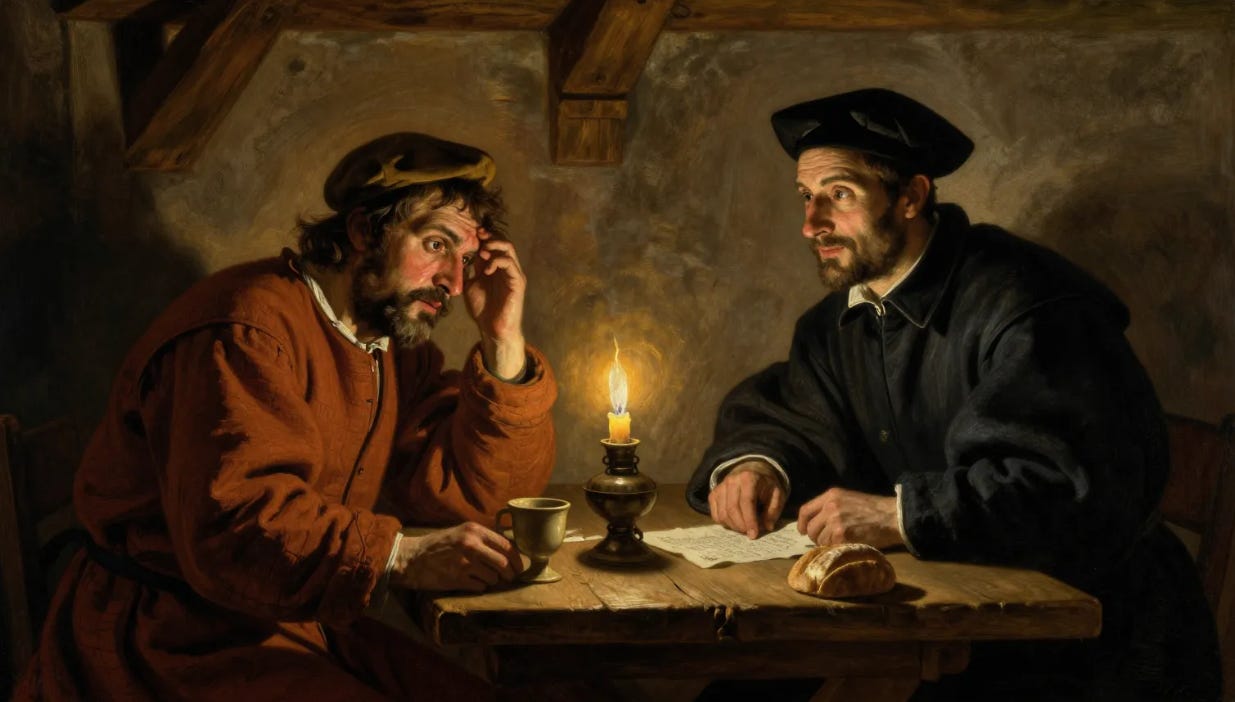
“And why should I be?” Ambroxio bursts angrily. He flags down a waiter and orders a cup of wine. “I’m sure you’ve seen the news. It seems the Holy Father has decided that we can no longer finance our enterprises.”
“Yes,” Luchino hides his smile. He’s smiling not because he takes any pleasure in his friend’s distress, far from it. But Luchino has been working on a solution, and he’s excited that his friend has this problem at the top of his mind. Ambroxio should be a very receptive audience to Luchino’s hypothesis.
Ambroxio continues, “So what am I to do now? Tell me, Luchino. I’m supposed to take my money, my hard earned money, money my family has been earning and saving and growing for generations now. I’m supposed to take this money, fund a voyage, and…what? What if it doesn’t make it back? What if those Venetian pirate bastards take my ship? What if God in His providence…” here the waiter brings the wine. Ambroxio holds his hand to keep the waiter, downs the cup of wine, hands back the empty cup and orders another.
Luchino laughs as the waiter walks away, “Ambroxio, just order a bottle!”
“No, no”, Ambroxio waves off his friend’s suggestion, “I can’t drink right now, it’s too early.” His eyes wander past Luchino as he tries to relocate his last train of thought. His eyes dart back to Luchino once his thought has been retrieved, “What if almighty God in his providence says, Ambroxio, I am taking your ship, your cargo, your crew down into the bottom of the sea? What will I do then? Tell me, Luchino. Before it was ok; that trip, that voyage was funded by my friends. Now MY MONEY goes down with the ship! Luchino, I’ve been losing sleep over this.” The waiter comes back. Ambroxio downs the wine. This time the waiter waited patiently for another order. Ambroxio downed this second cup just as quickly. He stared at his cup and considered if he should order another. Finally he relents, and the waiter is off to fetch more wine.
“Luchino, you might laugh, but I have been having dreams. Dreams, nightmares, omens perhaps about the fate of my business. I’ve watched so many ships go down in a storm, all my money, my ability to provide for my family, carry on our name, getting sucked into the ocean by hurricanes, or shipwreck on some godforsaken foreign shore. I think I’m ruined, Luchino. It’s inevitable.”
Luchino watches his friend patiently. Ambroxio looks up at his friend.
“I confess Luchino, you seem to me more amused at my angst than anything. You’re a merchant, are you not? Are you not concerned about this dilemma we find ourselves in?”
“I am”, replied Luchino cooly, “I’ve been thinking about this problem unceasingly. Ambroxio, I think I have an idea.”
The waiter arrives with the third cup. Instead of downing it, Ambroxio sets the cup down and waves away the waiter.
“Please my friend, enlighten me. Save me from my misery, my distress!”
Luchino smiles, “The Holy Father has indeed complicated our industry. We can no longer take out loans, make a successful voyage, then pay back our friends. But Ambroxio, what if we just did the same thing, but backwards?”
Ambroxio thinks for a minute. “Luchino, I don’t follow you at all. What do you mean?”
“Right now we take out a loan, complete the voyage, then pay back the loan with interest. But what if instead we paid at the BEGINNING of the voyage, before the trip was embarked upon?”
Ambroxio ponders again. “Pay at the beginning…for what? A loan? A loan to fund the trip? Luchino, that doesn’t make any sense….”
“No, no, no, not for a loan, but for a contract! Here, let me explain.”
Here Luchino looks at his notes on the table, “The interest we pay on the Sea Loan, it’s like a fee, correct? We pay a fee to borrow the money, the money that we then use to finance the voyage. I’m saying, ok…..so we’ll have to use our own money to finance the voyages. I don’t see any way around that. BUT we could buy a contract at the beginning of the voyage where the people we buy the contract from, they promise to restore us should we lose our ship and our merchandise.”
Ambroxio looks off as he tries to contemplate. He says slowly as if to facilitate his own mind’s processing, “a contract that….restores us….”
“Right! We buy a contract that says, “If I lose my ship, you will pay to restore me. If I lose 100 florins of gold, then you will restore to me the 100 florins of gold that I lost.” Do you see? We don’t even need a loan! We don’t need interest rates! We simply pay our friends, the same group of friends who gave us the Sea Loan, we pay them to give us a contract to restore us should we lose our ship!”
Luchino painfully waits for the lightbulb to go off over his friend. Ambroxio considers for a moment.
“So the same people that have been giving us Sea Loans…”
“We pay them to make a contract that restores us!” Luchino excitedly cuts in. “The ships you’ve been watching get destroyed in your dreams? God forbid such a thing occur, but…should such a thing occur, you simply take your contract to the merchant guild and have them make you whole, and restore you, for what you put on the contract. All your hard earned money Ambroxio? Protected by the contract.”
Ambroxio’s face softens. Luchino can barely contain his excitement. So far this “restoration contract” has only been an idea in his head and his notes.
Ambroxio cuts in, “So they get paid….at the beginning. Instead of at the end of a voyage. And they don’t have to put up anything at all.”
“That’s right!” says Luchino, “Before they had to put up the financing for a voyage. Now they put up nothing, they simply take the fee, the premium for the contract and wait to see if a ship will be lost or not.”
Ambroxio smiled, “I will not lie, Luchino, I was very skeptical of this idea at first. I’m still….I want this to work, believe me, and it sounds like it…can. Noone has ever done this before, this kind of contract that you speak of.”
Luchino nods, “As a notary I write all kinds of contracts. I can draw up a legally binding contract just like we described. We just need people to accept the money, the fee, and accept the risk. I don’t believe this will be hard though. They already accepted risk when they financed the Sea Loan. We just need to convince them to accept the risk from this restoration contract.”
Ambroxio nods and smiles. “Luchino, I salute you!” He downs the cup of wine.
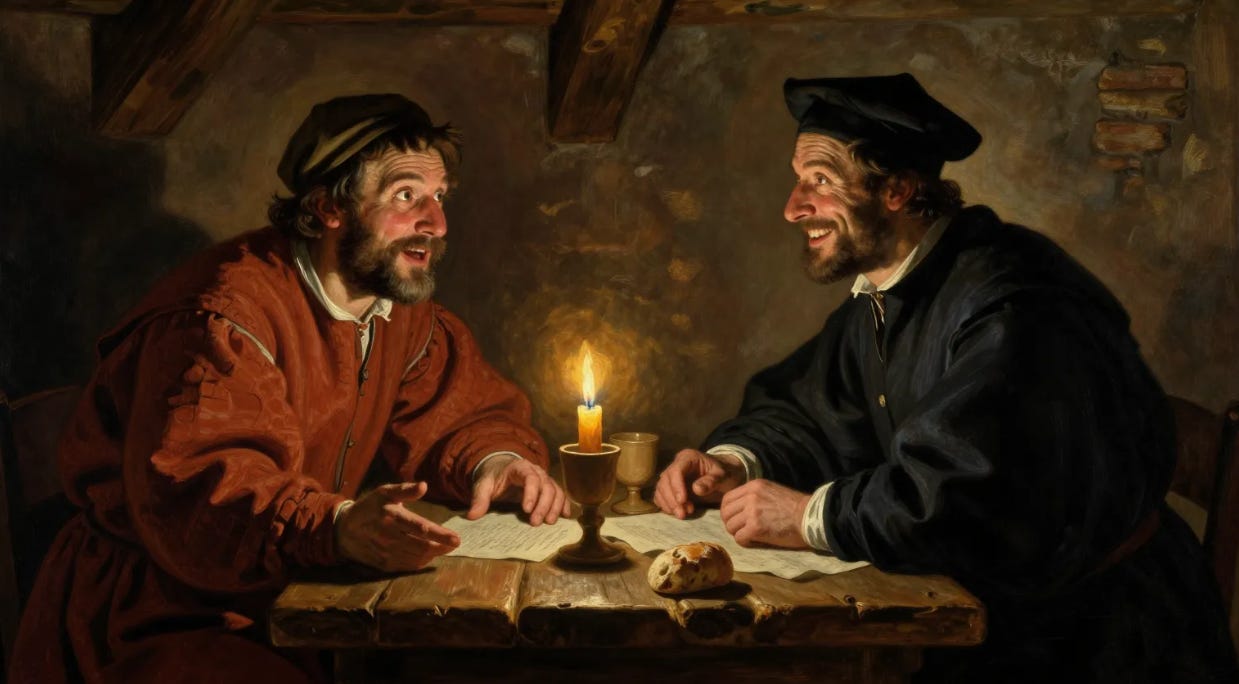
Luchino laughs, “Should we order a bottle now?”
Ambroxio shakes his head, “No, no, too early to drink.”
“But you’ve been drinking.”
“I have not! I’ve only had 2 cups of wine.”
“You’ve had 3 cups of wine.”
“I’ve only had 3 cups of wine. It’s too early to drink a bottle. Come, I have some goods I need to ship but I’ve been putting off because I couldn’t get a sea loan. Let’s draw up one of these contracts you speak of and talk to our friends.”
And THAT’s How I… Created Insurance
They say necessity is the mother of invention. Without a Catholic prohibition against usury, it’s possible that insurance would never have been developed in the first place. It took some innovative merchants in Italy to devise a way they could share their risks so they didn’t have to bear the danger of a catastrophe all by themselves.
The modern profit seeking insurance company would take a while longer to develop, but for now, at least in Italy, we have the beginnings of a tool, a contract that provides indemnification, making one whole again after a loss. It’s doubtful that they could have known how their innovations created an industry that would help bolster economies and facilitate global economies all these centuries later.
I love that the Church played such a large hand in the creation of insurance as we know it today! Thank you so much for this history lesson :)