

Regular readers of “0 Omissions” have probably noticed I’ve slowed down my output for this newsletter. It’s not because there’s been a slowdown of coverage gaps to talk about, I can assure you! But I’ve been deeply enthralled by some deeper questions; what’s it all for? Why does insurance exist? Does society need or benefit from the institution of insurance?
These questions I’m sure seem superfluous and unnecessary, especially for a newsletter written by a professional that relies on this industry to pay his bills! But my focus on coverage gaps has frustrated and baffled me, both with policyholders getting the shaft due to policy exclusions taken to their logical extremes and carriers getting boned with nuclear verdicts that seem to be calculated out of thin air. This adversarial relationship between policyholder and carrier I believe will continue to evolve (or devolve?) in such a manner that will eventually dissolve whatever fibers of trust remain in our western “high trust” society.
It’s hard to convince someone to engage in a marketplace that is designed to screw you should you foolishly or ignorantly sign the wrong contract or buy the wrong policy.
Let the Best Legal Team Win!
I realize that ultimately what I’m critiquing here is our American adversarial court system, a two sided contest where opposing parties put out their best arguments and allow a neutral party (a judge or a jury) to decide the case. While this system does have its strengths it also inadvertently creates the very contemptuous atmosphere that pits policyholder against carrier.
Policyholders are incentivized to work for their own immediate interests. If a claim arises then I need to secure coverage. I’m not incentivized to explain how my own behaviors or lack of controls created the environment for which a claim arose. I’m also not incentivized to point out any of my failures to comply with the conditions of the policy. I’m a business owner concerned about cost, and a claim produces costs that I have not budgeted for. If I can get a second party (the carrier) to pay, then I’m going to compel them to pay to the best of my ability. I’ll only cooperate if it benefits me directly.
Carriers are also incentivized to work for their own immediate interests. If a claim arises then the carrier needs to confirm if they’re obligated to cover the claim. If the carrier covered every potential claim that came through the door then there would be no carrier. Insurance carriers, like all private businesses, need to operate profitably in order to cover expenses and pay their employees competitive wages. But they also need to pay claims. If carriers never pay claims, then essentially what they’re selling is an insurance product that’s nothing more than a piece of paper. Carriers have to strike a delicate balance between paying claims they want and avoiding claims they don’t want.
Again, my existential questions about the insurance industry as a whole are to try and cut through this tension between policyholder and carrier. Their current relationship is going in the wrong direction. If carriers don't use the broadest, clearest and most unambiguous language possible to carve out what would otherwise be considered reasonable expectations, then policyholders can expect to win mind boggling astronomical payouts. Policyholders can either get royally and completely screwed or they can hit the lottery.
This adversarial relationship is not advantageous for either the policyholder or the carrier. The results from these winner takes all showdowns also begs an important question; what if insurance just, you know…worked? What if reasonable coverage expectations were met AND carriers were able to operate with more actuarial certainty then the last sixty years have provided?
This question led me to then ask; was there a time in history when insurance DID work, or at least operated more reasonably for both the policyholder and the carrier? This last question has led me down a long and interesting rabbit hole. And the short answer to my historical question, at least at these early stages of my research, has led me to believe that yes, insurance USED to operate more reasonably.
History Can Teach Us and Fix Us
My working thesis is; History can teach us how policyholders and carriers can work in a symbiotic relationship. Policyholders can access coverage reasonably and carriers can operate in good faith and with profitably.
I’ll be spending the next few articles drawing out some of the details of this fascinating history. The story of insurance is the story of us, the human race, and how we planned for and shared our risks.
Did you know that the first insurance contracts were drawn up in medieval Italy? Italian merchants created contracts with each other to offset the risk of losing their ships to storms or corsairs (pirates commissioned by neighboring city-states). They had to get around the Catholic Church’s prohibition against usury (interest rates) which cratered their previous seafaring financial instrument, the Sea Loan.
London also played a strong role in the development of insurance. 1601 brought about the “Standing Commission”, a tribunal that operated as a court of insurance. The preamble of the act that founded it perfectly encapsulates why a society would want to protect and cultivate a thriving insurance industry:
“Whereas it hathe bene tyme out of mynde an usage amongste Merchantes, both of this Realme and of forraine Nacyons, when they make any greate adventure (speciallie into remote partes) to give some consideracon of Money to other psons (which comonlie are in noe small number) to have from them assurance made of their Goodes Merchandizes Ships and Things adventured .. whiche course of dealinge is comonly termed a Policie of Assurance; by meanes of whiche Policies of Assurance it comethe to passe, upon the losse or perishinge of any Shippe there followethe not the undoinge of anv Man, but the losse lightethe rather easilie upon many, than heavilie uponfewe . . . .”
(I left the older English in tact just because it so fascinating!)
What’s the #1 reason why we want our society to cultivate a healthy insurance market? So when a business owner becomes subject to a claim “there followeth not the undoing of any man, but the loss lies rather easily upon the many, than heavily upon the few.”
Insurance exists so commerce can exist. So exploration can happen. So that people can take chances without ruining their lives. So society can advance and we can move into the future. We thrive when we share our risks.
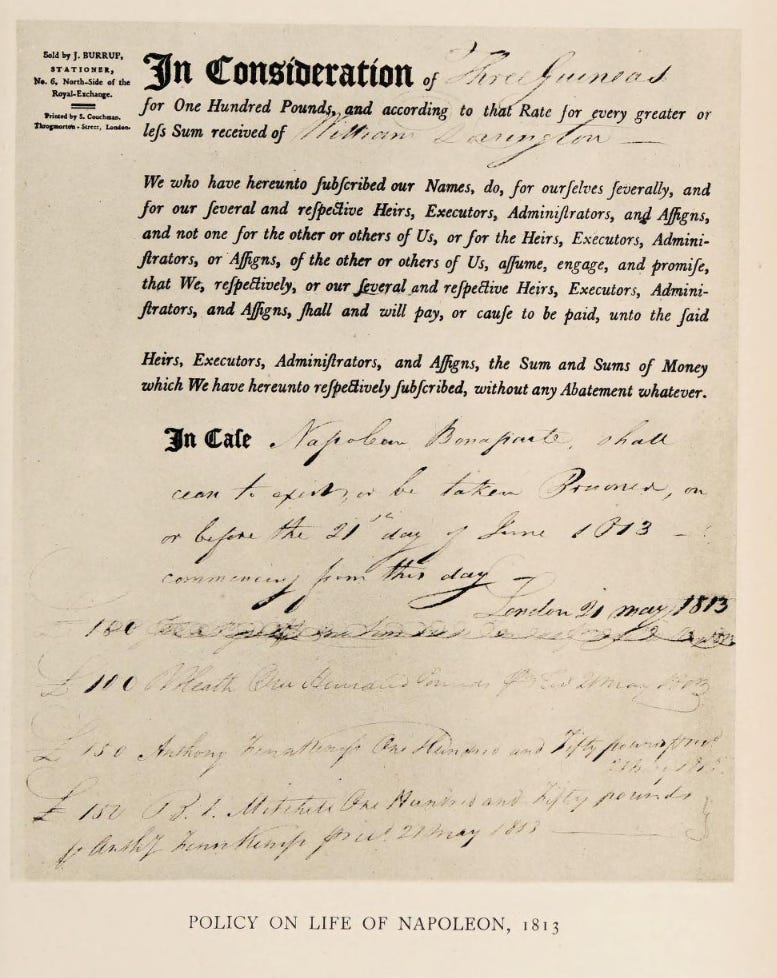
I’ll use the next few articles to trace the development of insurance from the marketplaces of Genoa to it’s formalization in London, all of it leading to the insurance policies we use today.
I am SUCH a huge insurance nerd, so THANK YOU for this article and those to come! I'm so excited to read more :)
Now this is my take from Canada, so I'm sure it's very different in the US, but I wanted to share my northern view. :)
"If the carrier covered every potential claim that came through the door then there would be no carrier."
True, if the underwriters aren't correctly assessing the risk that walks through the door. I would say that my team likely covers 95% of the claims that come to us. Why? Because our underwriters are very good at assessing risk, so most of our insureds never make a claim. And when they do, their brokers are educated enough to get their notice to carrier right. Sometimes they throw the spaghetti at the wall, but the brokers are pretty good about accepting the denial as reasonable.
Do you know what volume of coverage litigation occurs in the US? I don't, nor do I really know how much there is up here except for on my team. I'd love to find out. For my team, we've had four coverage claims that I know of in two years, and we've not lost any. I wonder how many are successful in the US - if it's a high percentage, then that would bolster your point.
"Carriers have to strike a delicate balance between paying claims they want and avoiding claims they don’t want."
I'd like to clarify that we "don't want" claims that the policy doesn't cover. :) I know there are some really awful, rotten, no good insurers out there with denial quotas that truly harm their clients. But there are other companies which truly want to service their insureds and give them what they paid for. The key is figuring out which is which and pointing your clients in that direction.
This brings up an important point - neoliberal capitalism creates a marketplace of individual greed. As you said, policyholders are incentivized to get as much as they can from their policies, as are insurers to give out as little as possible. I think it is this BELIEF about insurance that only makes both sides more polarized. Insureds believe the company will be out to screw them over, and insurers come to believe that the insureds are doing the same. And then these beliefs cause an even greater divide between the two sides, making things worse, as you say. And I agree, this is really hurting our industry.
On to the next point - I have great interest in going back to the early days of insurance when insurance was basically a co-op. Everyone throws money in the pot, and then if one of their homes burns down, they dig into the pot to pay to fix it. That also incentivized proactive protection, as everyone's money was in the same pot, and so making sure your neighbor's house was safe was as important as protecting your own. It also incentivized action, so if you saw someone's house on fire, everyone would volunteer to put the fire out ASAP, potentially lowering the quantum of damages. Now that insurance is faceless, no wonder all the incentives have ceased.
"Insurance exists so commerce can exist."
THIS! THIS SO MUCH! This is how I explain to people how important insurance is. If you could not guarantee that the goods you paid for would get to you, you wouldn't buy them. If directors and officers could get sued personally and lose everything, they would not serve on boards. If your car could be hit by someone without enough money to pay you a judgement, you wouldn't be willing to drive. And on, and on, and on. Insurance is what allows us to take risk every day, and without risk no one could operate in a capitalist society. Insurance keeps everything going. And that's why it's worth fixing the issues you note.
THANK YOU! I've nerded out enough :)